


Fifty and Counting - the birds of The Bosham Boathouse

Since we moved to Bosham at the end of 2019, we have kept a record of all the birds spotted in and around the house, either in the garden itself, flying overhead or in the fields surrounding the B&B.
Last week I saw the fiftieth different species that I have identified – there have probably been more, but my twitching skills are not as finely honed as some! There is a full list at the end of this blog but here are some of my favourites.
Wren
I love the song of the Wren with its distinctive machine gun finish – how something so small produces such a loud song is an endless source of amazement. In Spring, when the garden is a blanket of song, the call of the wren still bursts through loud and clear.
Sightings are less frequent as they are shy and fond of deep thickets and dark corners but I often catch sight of a jaunty tail disappearing into a bush as I come round a corner or brown blur darting from one patch of brambles to another. A common bird but one that always makes me smile.

Image by Siegfried Poepprel on Pixabay
Marsh Harrier
Perched on a post in the field opposite the Boathouse was what looked like a dark Buzzard. Birds of prey, whilst not uncommon, always give me a thrill and so I grabbed my binoculars for a closer look. Something didn’t look right, it was very dark apart from a creamy head and a splash of lighter feather on its wings and then in took off and I realised instantly what I was looking at as it started to patrol low across the field, only a metre or so above the ground. Its splayed tail, much less chunky than a Buzzard, confirmed that I had spotted a Marsh Harrier for the first time. I knew that there were occasional sightings around the harbour, particularly over the reed beds, but I had never been lucky enough to see one and now one had come to visit me. The bird cruised up and down the field a few times and then, not having had any luck in finding lunch, flipped up and over the pines at the far boundary and headed back to the harbour.
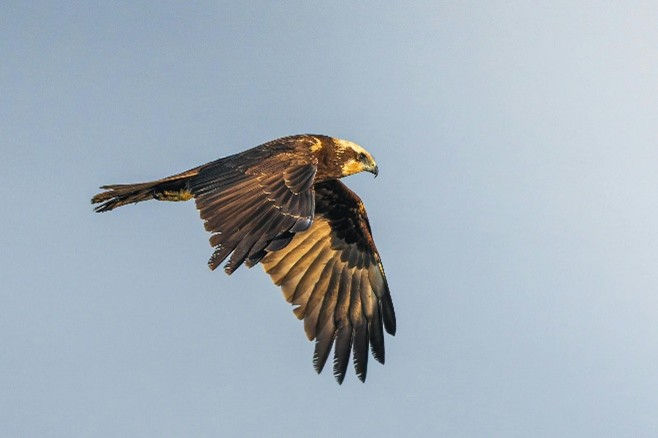
Image by Abhishek Navlakha on Pexel
Skylark
Like the Wren, the Skylark is another bird with a distinctive song more heard than seen. I don’t think there is a sound more certain to uplift the heart than a Lark’s fluid warble as it climbs into a clear blue sky. Not as widespread as they used to be due to the reduction in their habitat, they still manage to find a place to nest in the margins of fields around us at The Bosham Boathouse B&B.

Image by Kathy_Büscher on Pixabay
Red Kite
Thirty years ago, I was on a trip to Wales to try to sell some wine and, as I drove from Llandrindod Wells towards Newton, off to my left I saw a bird that thrilled me to my core. The elegant, back-swept wings and unmistakable forked tail flexing to adjust to eddies in the breeze – I was looking at a Red Kite for the first time! In the Nineties there were fewer than 100 pairs confined to a small patch of Wales and a few birds had just been introduced into England in the Chilterns - they were extremely rare and I felt incredibly lucky to see one.
Nowadays, due to the incredible success of the re-introduction programme that started not far from Oxford, Red Kites are a fairly common sight and, as their numbers have grown, so their territory has expanded and last year, for the first time, I saw one in Bosham.
Despite having seen hundreds of these birds over the past decades, the joy of each sighting is undiminished and every time I see one, I am reminded of that first one gliding alongside the A483.

Image by Kev on Pixabay
Green Woodpecker
I heard the harsh, laughing call of the green woodpecker for a week or so before I finally saw her – a flash of green and red out of the corner of my eye as she swooped across the meadow heading for the cover of the trees. Bird number fifty and time to write a blog!

Image by valpictures44 Pixabay
We have worked hard to encourage birds to the garden: we have created a wild flower meadow with plants selected both for food for the birds themselves and to encourage insects; built log piles and “insect hotels”; put up birdboxes and made our pond more accessible to birds. If you see something that is not on the list below, please let us know so that we can keep adding to the total.
The Full List:
Barn Owl Black Headed Gull Blackbird Blackcap Blue Tit Brambling Bullfinch Buzzard Canada Goose Carrion Crow Chaffinch Chiff Chaff Collared Dove Common Gull Cuckoo
Dunnock Great Spotted Woodpecker Goldcrest Great Tit Green Woodpecker Greenfinch
Grey Wagtail Heron Herring Gull
House Martin House Sparrow Jackdaw
Jay Kestrel Long-tailed Tit
Magpie Mallard Marsh Harrier
Mute Swan Pheasant Pied Wagtail
Red Kite Red-legged Partridge Redstart
Robin Rook Skylark
Sparrowhawk Starling Swift
Tawny Owl Thrush Treecreeper
Wood Pigeon Wren What's Next???
Comments